
Betrayed!

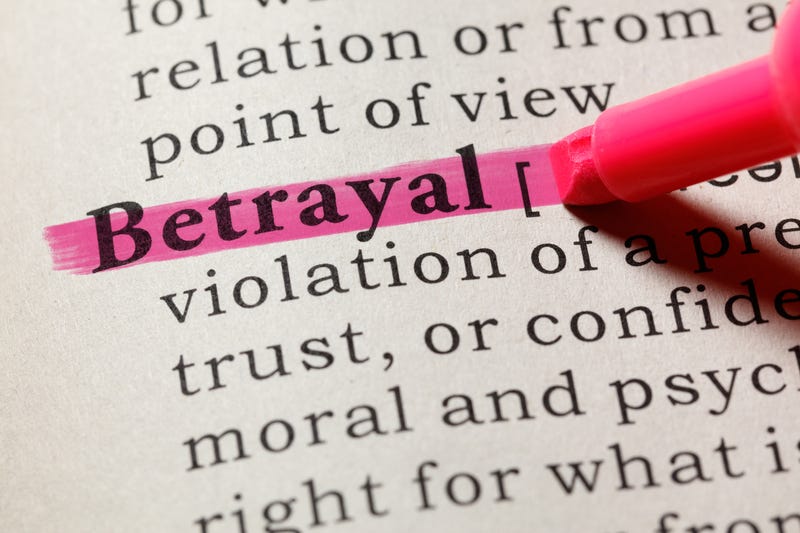
ID 121248502 | Betrayal © Feng Yu | Dreamstime.com
I was talking to my friend Sandy a few weeks ago. Over a latte and a bagel, we discussed the loss of another friendship of mine. I had been very close friends with a woman and her family. We had shared seven years of holiday meals, celebrated birthdays, and talked of shared vacations. As the distance between us had grown, I had asked several times if something was wrong between us. I always got the same response… “No! Nothing!” she told me.
“I feel so betrayed by her.” I said.
“You just need to let it go. Move past it. Forgive. Forget,” she responded.
Forget? I tried to imagine what that would be like. What about my God-given memory? Is there some form of Mr. Clean’s Magic Eraser for the brain? What if I think I’ve forgiven, but it feels like I haven’t when the memory of betrayal comes roaring back? What do I do when a present situation reminds me of that betrayal all over again.
I’m not sure there’s anyone who hasn’t experienced feeling betrayed at one time or another. Maybe you were betrayed by a lover or spouse who lied or was unfaithful? Maybe a friend betrayed you by telling someone something you told them in confidence? Maybe a church turned its back on you when you needed that community the most? Maybe someone, with no explanation, pulled away from you after years of what you thought of as a lifelong friendship, and you were left confused, perplexed, and hurt?
How do we move on? How do we heal? How do we trust again?
When one person knows that what they say or do will hurt the other person, but chooses to do it anyway, a betrayal has occurred.
I’m thinking we all have a story or two about being betrayed. Some of us have had wayward spouses. Others have had good friends lie or gossip about us. Some have felt the sting of being unceremoniously dumped. Maybe a friend suddenly stopped calling or wanting to spend time with us. Excuses come more frequently. These types of things can break relationships and cause us to distrust other people in the future.
Sue Johnson, a psychologist known for her work on human bonding and attachment theory, stated that our greatest need [as humans] is safe emotional connection and responsiveness from significant others, a need rooted in our evolutionary history and survival instincts. We are wired to ask “Are you there for me?”
“Isolation and the potential loss of loving connection is coded by the human brain into a primal panic response.” ~ Sue Johnson
More complicated betrayal trauma can happen when we are reliant on the support of a parent, a spouse or even an employer. A child who depends on his parents to take care of him will begin to ignore the betrayal in order to survive in the home. A woman who is does not work outside of the home may ignore her suspicions of infidelity because her husband is providing her with financial support.
I once worked for a large manufacturing company. This company was one of only two major employers in the small city where I lived. The owner was emotionally abusive and seemed to get pleasure out of keeping his staff constantly fearful of termination. He enjoyed humiliating people in meetings in front of others. We who worked there joked that if you went to work there and were still working there six months later, chances are you had been raised in a dysfunctional family. In other words, this is just more of the same.
As a single mother raising two children by myself, I needed that job. I found myself in the doctor’s office often. I was only forty-years-old when I got my first EKG. That was over thirty years ago now and I still have friends all over the country who used to work there. We all have a shared past of being betrayed by the owner of that company.
Trauma lives in our bodies, sometimes years after the initial hurt happened. We can forgive the perpetrator, especially if they stop the behavior or are not a significant part of our lives. But unless we have reached a point of significant healing, someone (maybe even that same person) can do something that causes us to remember the initial betrayal, and to feel similar feelings of hurt, anger, and anxiety all over again. When that happens, it’s important to understand what is happening and help ourselves continue to heal.
It's also important to realize we have a choice. The betrayal hurt us…it hurt like hell. But living without love from others, or holding on to a life filled with distrust, is also extremely painful and may be even more so. We may never experience that freedom to trust and love someone again if we choose the route of protection. Learning instead to recognize red flags and set up healthy boundaries is a much more joyful way to live. We want to grow stronger and better throughout our lives…not get stunted or stuck.
Here are some ways we can help ourselves.
Figure out if the person deliberately betrayed you (like infidelity) or accidentally betrayed you (like forgot to pick you up or forgot a coffee date.
Feel the feelings and process through them without trying to push them away or get swallowed up in them.
Be kind to yourself. Try not to give yourself negative messages such as, “I’ll never trust another friend.”
Know whether or not you should continue on in the relationship or cut ties completely. Is what happened a pattern with this person? How often do you feel betrayed by them?
Determine that there are plenty of people who would care about you and be safe in a relationship. Now you have learned, and grown, you can develop insight, watch for red flags, and have healthy boundaries in order to keep yourself safe.
Talk through the betrayal with another trusted friend or a counselor.
When that woman friend betrayed me, I wrote her a letter on my computer about my feelings. I didn’t send it. Over time I rewrote it several more times. In it, I said exactly how I felt about being “unceremoniously dumped.” I read it to my husband. “If you send that letter, she will be in your head a lot more. You will wonder if the letter arrived. You’ll wonder if she read it. Did she read it to her husband? Will she write you back? You will be constantly thinking about her and about what she did again.”
He was right. I chose not to send it. But the act of processing my feelings through words did help me. I was able to let go of the pain and move on to forge new friendships.
I think it’s important to know that we can be more attracted to certain types of people because of our own backgrounds. This can lead us to put ourselves in the position of getting hurt simply because we find we “click” with certain types of people. They may feel familiar and we may think we’ve found an instant best friend because we feel so comfortable around them. This is when we need to slow down and wait long enough to get to really know the person. This is also the case in romantic relationships.
We can begin to think that most or all people aren’t trustworthy. We don’t realize that we are swimming in a small neighborhood pool with certain types of people when over on the next block, there’s an Olympic size pool full of wonderful folks who would prove themselves worthy of knowing you.
Have you ever felt betrayed by someone you cared about? Me too. Let’s refuse to let this define us and keep us from putting love out into this hurting world.
If you liked this post, please let me know by clicking the heart button. If you know someone who may benefit from it, please restack. We have great conversations over here. Let me know your thoughts!